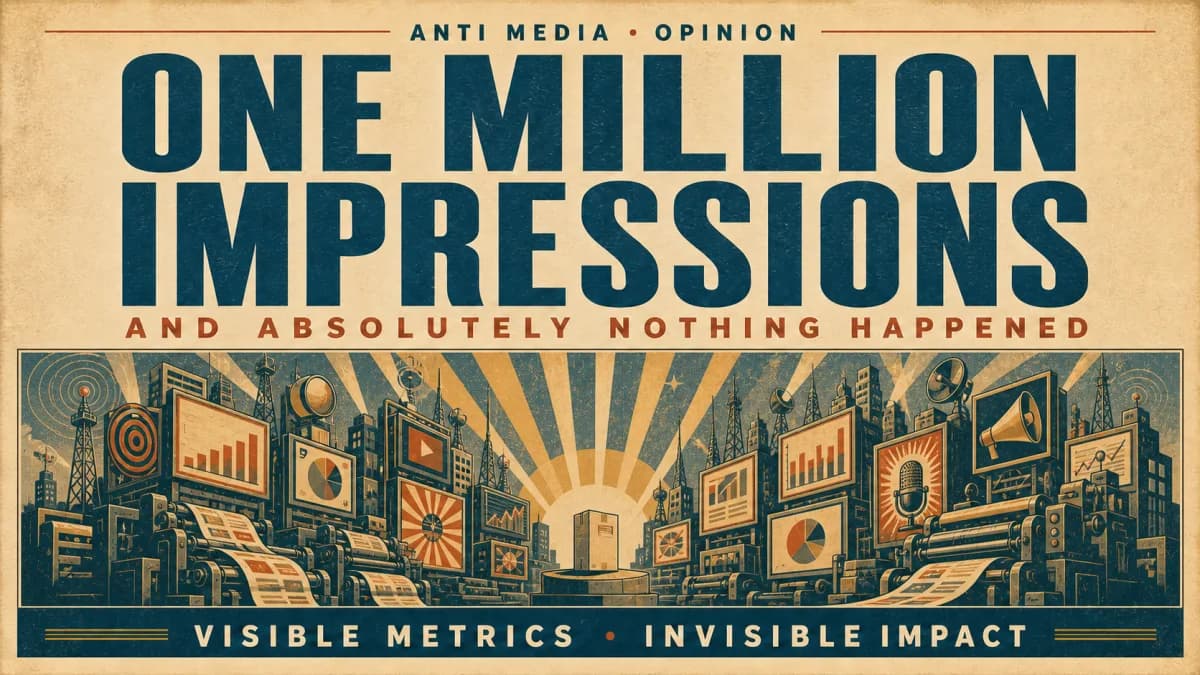
The campaign report looked excellent.
1,000,000 impressions.
And absolutely nothing happened.
The numbers in this article are illustrative. The report is fictional. The pattern is not.
The campaign was a success.
The dashboard was green. The chart moved up and to the right. One million impressions arrived exactly as ordered, followed by eighteen thousand clicks, seven hundred registrations and a presentation full of arrows explaining why the next budget should be larger.
Everyone on the call congratulated the agency.
Nobody could remember the product.
Start with the largest number
One million is an excellent number because it takes up most of a slide.
Nobody asks one million what it saw. Nobody asks whether it was a person, a bot, the same person twelve times or a video playing silently below an article about something else. The number has already done its job. It entered the room before the questions did.
Impressions are real events. They are simply not evidence that an impression was made.
That distinction is inconvenient, so the report moves quickly to clicks. Clicks are smaller than impressions but sound more physical. Somebody pressed something. We are getting warmer.
The report does not mention that a click can be accidental, incentivized, mislabelled or produced by a person who forgot the page before it finished loading. That belongs in a different tab. This tab has arrows.
An impression happened to the server. A memory happens to a person.
Add enough intermediaries
The cleanest campaign has one buyer and one publisher. This is why the cleanest campaign is rarely available.
A more sophisticated arrangement has a brand, an agency, a media buyer, an affiliate network, a sub-network, a placement partner and an account manager who will ask the placement partner where the placement appeared.
Every handoff adds a dashboard. Every dashboard adds certainty.
By the time the work reaches the person who actually posts it, the original brief has become three words and a tracking link. The author does not know the product. The brand does not know the author. The audience is the only party expected to understand what is happening.
This is called scale.
Optimize everything except recognition
Recognition is difficult to buy because it requires continuity.
A person has to encounter the same idea more than once, in places that make sense, expressed by sources they do not immediately distrust. The product needs a stable name, a clear reason to exist and public evidence that survives longer than a media flight.
None of that fits neatly into a cost-per-thousand spreadsheet.
So the campaign optimizes what fits. The cheapest impression wins. The cheapest click wins. The cheapest registration wins. Quality is discussed after volume, usually when there is no budget left to repair it.
For iGaming, this can produce a particularly elegant result: a database full of accounts and no durable demand. Remove duplicate registrations, bonus abuse, failed verification, one-session users and people outside the permitted market. The line becomes quieter. Reconcile retention and net value. Quieter again.
The presentation keeps the first line.
Stop spending and perform the visibility test
The fastest way to understand a campaign is to turn it off.
Does anyone search for the brand by name? Does a useful discussion remain? Can a customer find a real explanation from somebody other than the company? Does an AI answer know what the product is, who it is for and why it belongs in the comparison?
Or does the entire market presence disappear at the exact second the insertion order ends?
Rented reach is allowed to stop when payment stops. That is the agreement. The mistake is reporting rented motion as accumulated reputation.
The campaign was not badly executed.
It did exactly what it was designed to do:
make the report look successful.
The million impressions were not the failure. They were the distraction.
The failure happened earlier, when nobody defined what should remain after the impressions were gone.
Build something that leaves a trace
A useful campaign can still buy reach. It can still use affiliates, creators, search and performance pricing. The difference is that every unit of work has an identity.
What was the task? Who performed it? Where did it appear? Was the relationship disclosed? Can the brand inspect the result? Did it answer a real question? Is the page still useful when the campaign label is removed?
That is the logic behind AntiMedia's task model. The product and requirements are turned into explicit assignments. Real authors choose the work, publish through their own accounts and submit a live result for moderation. The output is a public URL, not a promise hidden inside a bundle of signals.
It is less impressive than one million when placed in 72-point type.
It is much more impressive when somebody asks where the work actually is.
Public contributions can accumulate. They can be found through search, discussed inside communities, retrieved by AI systems and revisited by people who are still making a decision next month. Not every post will rank and not every mention will be remembered. At least each one has the opportunity. An invisible placement does not.
If you want to be seen, buy impressions.
If you want to be remembered, give people something to say.
Want work you can inspect instead of volume you have to imagine? Tell us about your product through the contact page.