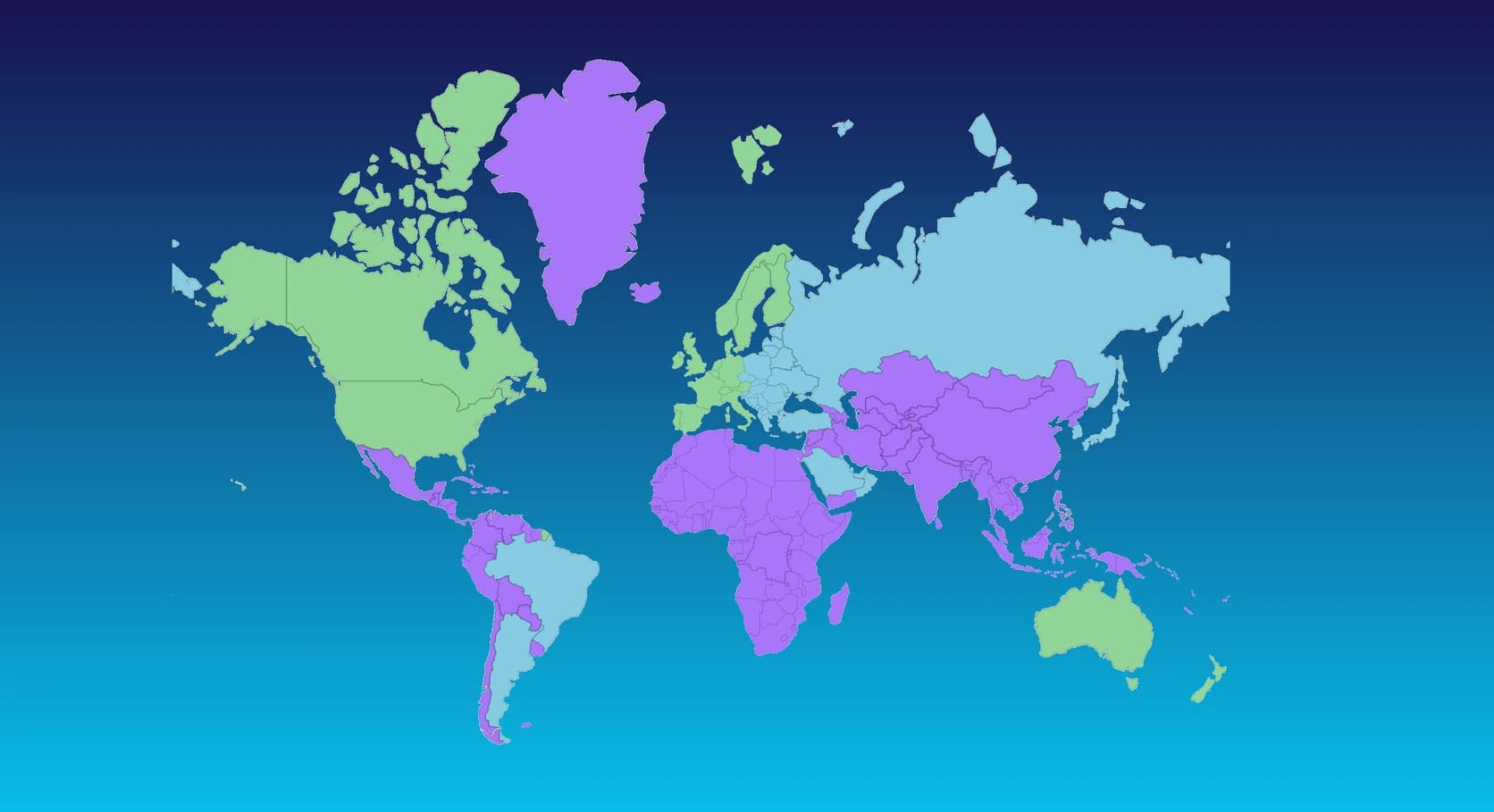
Tier 1, Tier 2 and Tier 3 GEOs: server location, latency and conversion
“Tier 1/2/3 GEO” is convenient shorthand, but it is not a technical standard. In marketing it often describes a rough mix of purchasing power, advertising cost, payment availability and competition. In infrastructure, the question is different: where are users, where is the data, and how quickly can the first useful screen appear?
The useful rule is this: choose the GEO for the business model, then choose the server region for the audience and data path. Do not use a country tier as a substitute for either decision.
The practical difference between tiers
| Group | Typical characteristics | What usually gets harder | What to test first |
|---|---|---|---|
| Tier 1 | Higher purchasing power, mature payment and ad markets | Higher CPC/CPM, stricter compliance, stronger competition | Offer trust, payment flow, local support |
| Tier 2 | Mixed cost and purchasing power, growing digital adoption | Country-to-country variance | Local payment methods, language, mobile speed |
| Tier 3 | Often lower media cost and more uneven infrastructure | Connectivity, payment coverage, volatility, support load | Page weight, device mix, fraud controls, fulfilment |
These labels are not a score for the people in a country and they are not permanent. A market can be “Tier 2” for one vertical and behave like “Tier 1” for another. Treat the tier as a starting hypothesis for planning, not as a targeting rule.
Does a closer server improve conversion?
Sometimes. Network latency is the delay between a request and a response. The first request includes DNS, TCP and TLS work; a page then creates more requests for fonts, scripts, images and APIs. More distance and more round trips can make a slow experience visibly slower. (MDN: Understanding latency)
But “move the server closer” is not a universal conversion lever. A heavy page, slow third-party script, overloaded database, payment provider or a 5 MB hero image can dominate the result. A CDN can make static files fast near users while the origin remains in one region. The answer comes from measurement, not from a hosting map.
AWS makes the same core recommendation for distributed workloads: selecting a region close to the majority of users can reduce latency, while data location, security and compliance must also be considered. (AWS Regions)
What belongs near the user and what belongs near the data
Use this split when planning infrastructure:
- Static landing assets: put behind a CDN. Images, CSS, JavaScript and fonts benefit most from edge caching.
- Landing-page origin: start in the region closest to the largest real audience cluster, not the country where the team works.
- Tracker and redirect endpoint: keep response time predictable, log the selected region and avoid unnecessary redirect hops.
- Database and CRM: keep the application close to its primary data store. Cross-region database calls can erase the gain from a nearby frontend.
- Postbacks and payment callbacks: optimise for reliable delivery, signatures, retries and observability first; a few milliseconds matter less than a lost event.
For multi-region applications, latency-based DNS routing can send a user to the region with the lowest measured latency, but it adds operational complexity. It is worth it only after a single-region origin plus CDN has been measured and found insufficient. (Route 53 latency routing)
A 30-minute GEO and server test
Before committing a budget, run the same controlled test in each target market.
- Pick one landing page, one offer and one traffic source.
- Record country, network type, device, carrier when available, and the exact final URL.
- Measure TTFB, LCP, checkout or lead-form completion, and postback arrival separately.
- Test from real mobile networks or credible synthetic locations, not only from your own laptop.
- Compare a CDN-on and CDN-off baseline if you control the origin.
- Change one variable at a time: region, page weight, payment method or creative.
The outcome you want is not “the fastest server.” It is a reproducible answer: for this audience and flow, a page from region A reaches a usable state sooner and completes more desired actions than region B.
Server location is only one conversion variable
Conversion is affected by relevance, price, creative, trust, local language, payment methods, device performance and connection quality. Web performance still matters: slow pages increase abandonment, while reducing load and render time can improve retention and conversion. (MDN: why performance matters)
That is why a simple page in a farther region can outperform an overbuilt page hosted nearby. Optimise the experience in this order:
- Remove unnecessary scripts and oversized media.
- Cache static assets at the edge.
- Reduce redirect chains and third-party dependencies.
- Locate the application and database sensibly.
- Add extra regions only when measurements justify the cost.
Where is it easier to launch?
“Easy” has at least four meanings: cheaper traffic, fewer compliance constraints, accessible payments and lower operational support. They rarely align in one country. Build a launch scorecard for the exact vertical:
| Question | Evidence to collect |
|---|---|
| Can users pay? | Local cards, wallets, bank transfers and approval rates |
| Can you advertise compliantly? | Platform policy, local restrictions and creative requirements |
| Can users load the flow comfortably? | Real mobile speed, device mix and page-weight test |
| Can you support the customer? | Language, timezone and dispute process |
| Can you measure the outcome? | Click ID continuity, event logs and reconciliation |
The market with the lowest click cost is not automatically the market with the lowest acquisition cost. If payment or onboarding fails, cheap traffic only makes the failure more visible.
Decision checklist
Choose a GEO and server setup only after you can answer these questions:
- Who is the initial audience, down to country and device mix?
- Is the page fast on their mobile connection, not just on a desktop office network?
- Where are the origin, database, tracker and payment callbacks located?
- Is a CDN serving every cacheable asset?
- Which conversion event is the actual decision metric?
- Do you have a baseline before changing server location?
Tier labels help organise a conversation. Performance data, payment reality and user trust decide whether the campaign works.