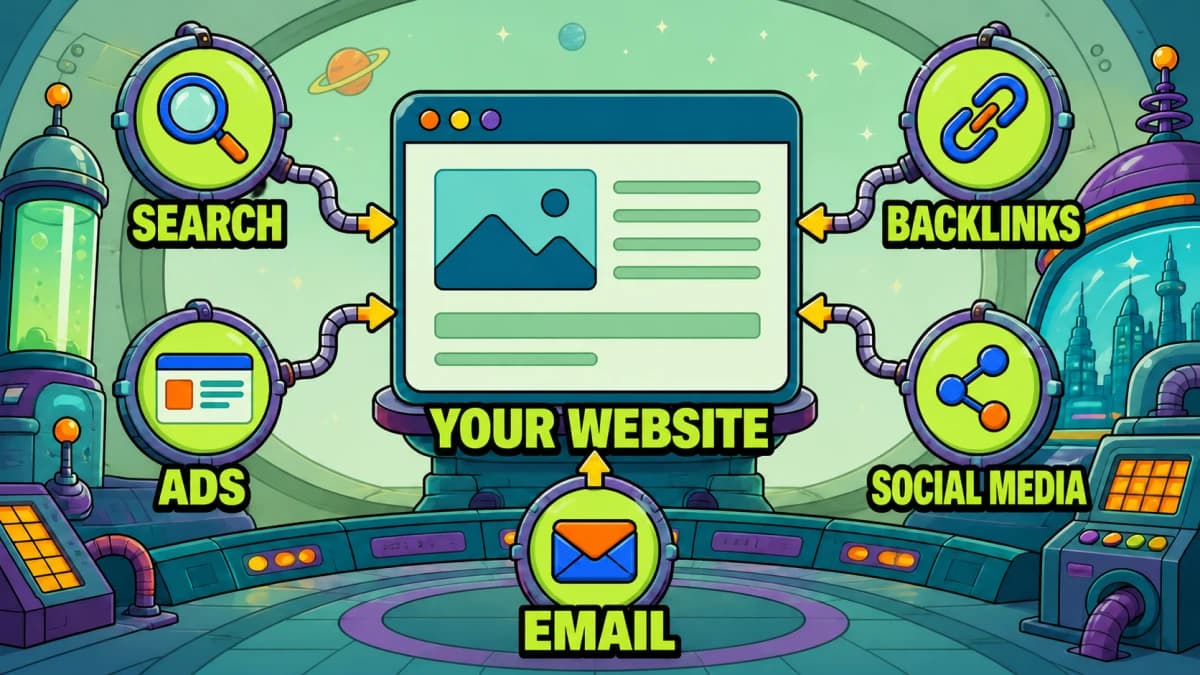
Most sites that lost organic traffic did not lose their rankings. They still sit where they always sat. The page around them changed, and the click that used to be theirs now goes somewhere else on the same screen.
So the useful question is not "how do I rank higher." It is "where does the traffic for my queries actually go now." Those are different questions, and only the second one tells you where to work.
Look at the result page before you look at your position
Take your five most valuable queries and search them the way a real person would, on a phone, logged out. Then count what is above your result.
An AI summary. A video carousel. A forum thread. A comparison site. A map pack. Four or five things that answer the question before anyone scrolls to a classic link. Your rank is the same as last year. Your share of the screen is a fraction of what it was.
That screen is the real ranking. Everything below is worth what is left over.
The places the traffic went
AI answers. When a model writes the answer instead of listing links, it pulls from sources that read like genuine consensus. Being the cited source is the new first position. It is not won with meta tags, it is won by being mentioned in the places models trust.
Community threads. Queries loaded with doubt, "is it worth it," "is it a scam," "which one actually pays," now surface discussions first. We wrote about why a comment can outrank your homepage. The short version: your page says what you want heard, the thread says what people experienced.
Feeds, with no query at all. Google Discover sends traffic to people who never searched for anything. It is a different game entirely, driven by the cover image and the headline rather than keywords, and small publishers can win it.
Other people's rankings. For most commercial categories the top of the page is owned by comparison sites, aggregators and marketplaces. You are not going to outrank all of them. You can be the option they list.
Video. A large share of "how to" and review intent now resolves in video results, often above the text ones.
Find your own gap, do not guess
Three checks, in order of how much they tell you.
Impressions without clicks. In Search Console, sort your queries by impressions and look for the ones with a click rate far below what the position would predict. That gap is traffic being taken above you. Those queries are where the page changed, and they point straight at what is sitting on top.
Ask the models. Put your category question to ChatGPT, Gemini and Perplexity, and read who gets cited. That list is your real competitor set for AI visibility, and it usually has little to do with who ranks first in Google.
Read the threads that already rank. For any query where a forum result is winning, that thread is a transcript of the objections your audience actually has. It is better research than a keyword tool, and it tells you what to write next.
What does not work
Publishing more pages of the same kind. If the problem is that the blue link region shrank, filling it with more of your links does not help.
Chasing a rank you already have. Moving from position four to position two is worth very little when the top of the page belongs to something else entirely.
Manufacturing the mentions. Fresh accounts posting praise on cue get removed, and one exposed campaign costs more than the mentions were worth. The mentions that hold are the ones you did not write.
The honest summary
SEO used to be a position. It is now a share of a crowded screen, plus a share of the answers that never show a screen at all.
The work follows the same logic it always did: be genuinely useful somewhere people already are, and let the ranking be a consequence. What changed is the list of places that counts, and the list is longer than your own domain.