
Budget season is the wrong time to discover that a channel closed. This guide is written for the plan you are drafting now, for the last quarter of 2026 and the first of 2027, and for brands that platforms treat as sensitive: iGaming first, but the logic holds for crypto, supplements and anything else that gets its ad account reviewed more often than it gets renewed.
The structure is simple. What changed this year, with dates. Where the money can go, source by source, with what has to be true for each one to work. What to stop paying for. And a starting split you can adjust for your own numbers.
What changed in 2026, with dates
Google tightened both ends of search. The August 2026 spam update ran from 18 to 21 August and was the harshest of the year by the ranking data that followed it. Six days later, on 26 August, Google rewrote certification for online gambling advertisers so that ads must link only to fully licensed and authorised entities in the targeted region. Our analysis of the spam update covers what that means for a site that lived on grey links. The short version: there is no longer a ranking trick that survives the next update, and no longer an ad route that skips the licence.
Fewer searches send a click at all. SparkToro's 2026 clickstream study found that less than one third of Google searches now send a click to any website, a drop of about nine and a half percentage points since 2024. A randomised field experiment by Saharsh Agarwal and Ananya Sen, published in April 2026, put a number on the AI Overview specifically: when one was shown, organic clicks fell by 39.8% while clicks on sponsored results stayed flat. Read that second half twice. The answer box took the organic click and left the paid one alone.
Ads arrived inside the answer. OpenAI moved ads in ChatGPT from a test to a self-serve product this year. Our ChatGPT ads guide separates the paid slot from the organic citation, and the distinction matters for the plan below: one is bought, the other is earned by being the source the model quotes.
Video platforms drew their lines. YouTube's expanded gambling rules took effect on 17 November 2025: no links, logos or spoken references to gambling services that are not certified, no content promising returns, and an 18+ restriction that now covers simulated casino play. Twitch still bars creators from promoting slots, roulette and dice sites, spelled out again in enforcement notes in January 2026, while the platform itself began running betting ads to US viewers in December 2025. Creator promotion is closed; platform inventory is open. Plan for both facts.
Installs got harder off-store. Google's Android developer verification started rolling out in August 2026. Our breakdown of what changes covers the friction for apps that live outside the Play Store, which for many iGaming brands is the only place they can live.
None of this is a surprise if you read the policy pages. It is a surprise if you read only the dashboard.
The best traffic sources for iGaming in autumn 2026
Each source below gets the same three lines: who it suits, what has to be ready, and what to measure. Skip the ones where the second line is not true for you.
Microsoft Advertising (Bing Ads): the underpriced source for gambling
This is the underpriced source of the year, and it has been for a while. Bing held 4.47% of worldwide search in August 2026, which sounds like nothing until you look at desktop, where it is 8.84%, and at who is on it: Windows defaults, Edge, older and higher-income users, and now Copilot. Industry comparisons put the share of US advertisers active on Microsoft Advertising at roughly a third of those on Google, with clicks priced a third or more lower for the same intent. Less competition for the same person typing the same query.
Two things make it more than a discount channel in 2026. First, Microsoft's gambling policy is explicit and workable: gambling ads are allowed with market restrictions, you apply through a participation form, you prove the licence, you geo-target the approved market and age-target 18+ or the local legal age. The policy was last updated on 13 May 2026. Second, search ads now extend into Copilot: AI Max for Search entered open pilot in May 2026 and delivers into Copilot Search and Copilot Answers, and Performance Max includes Copilot placements. That is paid presence inside an AI answer, in a market where the answer is eating the organic click.
Who it suits: a brand licensed in at least one market Microsoft preapproves. What has to be ready: the licence document, the participation form filed, a landing page that identifies the operator. What to measure: cost per first deposit against the same query set on any other search you run.
Reddit, communities and AI visibility
When a person asks ChatGPT, Gemini or Perplexity which sportsbook is safe in their country, the answer is assembled from what real people wrote in public: Reddit threads, forum comparisons, reviews, guides. The model cites the sources it trusts, and a brand that appears in those sources appears in the answer. Our iGaming SEO guide covers this in depth, and our Reddit piece explains why community threads rank in Google too.
Reddit Ads is also open to real-money gaming, with conditions: advertisers must be pre-approved, work with Reddit's ad team, and target only countries where gambling advertising is legal. Paid and organic on Reddit are different budgets with different rules, and the organic side lives or dies on subreddit moderators.
This is where AntiMedia's own service sits. Brands post tasks; real authors write honest posts and comments with disclosure where the platform requires it; moderation rejects what reads like an ad. No promise of a ranking, because nobody can make one honestly. What you get is a visible list of placements you can inspect, which is the audit trail the next section asks for.
Who it suits: a product that survives an honest review. What has to be ready: a page that answers the questions people actually ask, in the languages of the markets you serve, and a rule for disclosure. What to measure: mentions and citations by market, then registrations from those referrers.
Direct channels: Telegram channel, email, push
The one line that repeats in every article on this site is the one that matters most in a plan: own the channel nobody can revoke. A Telegram channel, an email list and push subscribers keep working through an ad account review.
Be precise about what Telegram allows. The official Telegram Ads platform prohibits gambling and betting ads, and that includes tips, odds and picks. Third-party networks sell placements inside channels, which is a deal with a channel owner, not with Telegram, and it comes with the channel owner's audience quality and the channel owner's risk. Building your own channel is the part that compounds.
Who it suits: everyone, from the first month. What has to be ready: a reason to subscribe that is not a bonus, a posting rhythm, unsubscribe and consent handled by the book. What to measure: the share of first deposits that come from people who were already subscribers.
Creators and iGaming affiliates, paid for outcomes you can trace
Creator promotion of gambling is closed on Twitch and tightly fenced on YouTube, so the money moves to creators on platforms where disclosure and licensing rules allow it, and to affiliates who send traffic you can trace to a registration. The GTA 6 sponsorship analysis is the checklist for telling a large audience apart from an available placement.
Affiliates are where autumn budgets leak. Our Argentina story follows resold traffic through three hands to find that the original audience was never what was sold. Ask every partner the same question: who produced the visit, and what did you add?
Who it suits: brands with a tracking setup that survives a redirect chain. What has to be ready: a brief with disclosure rules, a payout tied to a first deposit, a right to see the placement. What to measure: return rate at 30 days by partner, not volume.
Native ads: Taboola and similar networks, where the licence allows
Taboola and its peers accept gambling as a restricted category: licensed in the region, responsible gaming messaging, the advertiser named. Approval is slow and the creative rules are strict. It is a real channel for a licensed operator in Europe or Latin America, and a dead end for anyone hoping to run a bonus-first page.
Who it suits: licensed operators with editorial-style landing pages. What has to be ready: a compliant page per market and creative without a promise in it. What to measure: registration cost by publisher, with the worst quartile of publishers cut every two weeks.
Apps and mobile web
The Android and iOS acquisition guide follows installs through registration, first deposit and retention. After developer verification, the question for autumn is narrower: does the app make a task easier than the mobile site does? If it does not, the install is a cost, not a channel.
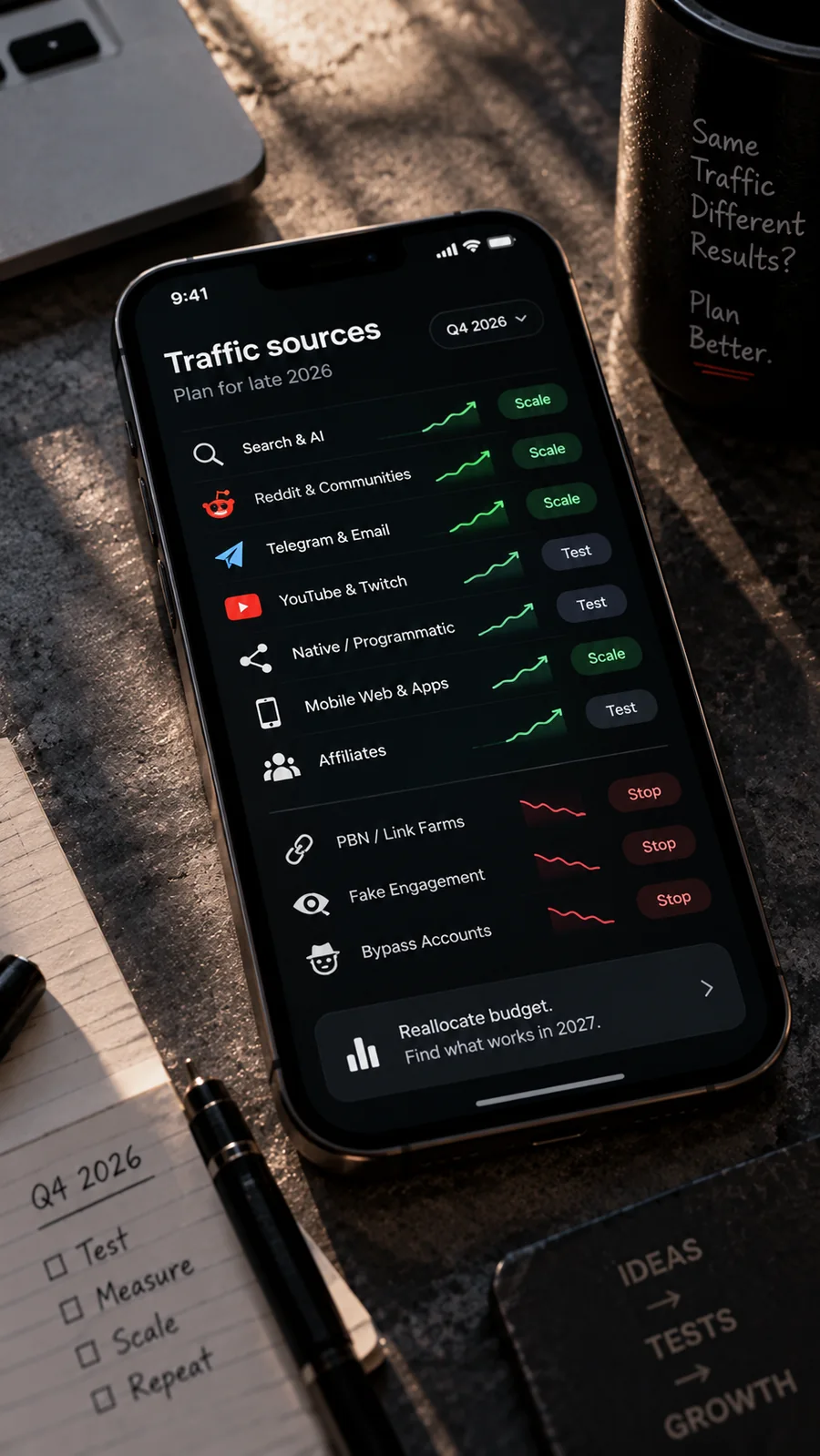
Traffic sources to stop paying for
Some of this is still in autumn plans because it was in last autumn's plan.
- PBN links and rented site networks. The August update named the behaviours, and the next one will too. Every dollar here is a dollar that buys future removal.
- Views, impressions and engagement bought by the thousand. Our one million impressions story is fictional on purpose; the reporting logic it describes is not.
- Generated comments at scale. Platform anti-fraud catches the same account, the same pattern and the empty history. The mentions that survive are the ones a person wrote.
- Reopening a banned ad account under a new entity. The certification rules now tie the ad to the licence holder. A new entity without the licence is the same ban with a delay.
- Creator deals on platforms that prohibit them. A sponsorship Twitch or YouTube will remove is money paid for a takedown.
How to split an iGaming marketing budget
Three rules travel well across markets.
Reserve ten percent for one new test a month. Not spread across five ideas. One source, one market, one page, one month, with the outcome named in advance. A test that competes with your working channels for budget will be starved the first time the working channel has a good week.
Weight toward what you keep. In a plan for a sensitive vertical, the sources that survive a policy change should hold more of the budget than they would in a plan for a shoe brand, even when their cost per deposit is slightly worse. You are paying a premium for the reach that is still there in January.
Move money on deposits, not clicks. A source that sends cheap clicks and no deposits is expensive. A source that sends dear clicks and returning customers is cheap. The impressions versus awareness piece explains why the reporting layer hides this by default.
Measuring it so the next plan is easier
Define four events and report each source against all four: click, registration, first deposit, and a second session at 30 days. A click is a cost. A registration is a lead. A first deposit is a customer. A return is a business. Sources that look identical on the first line separate on the third and fourth.
Keep one more column: what the source needs to keep working. A licence, a moderator's goodwill, a channel owner, a creator's platform, a store's review. That column is the risk register, and it is the reason the autumn plan should not look like a shoe brand's.
The first 30 days of Q4
Week one. File the Microsoft Advertising gambling participation form for your licensed markets. Write the disclosure rule for authors and creators. Define the four events and check that your tracking survives a redirect.
Week two. Launch search on Microsoft in one market. Start the Telegram channel or restart it with a reason to subscribe. Brief two community tasks around the questions your support team hears most.
Week three. Ask every affiliate and reseller for the placement list. Cut the ones who cannot produce it. Pick the one new test for the month and write down what would make you stop it.
Week four. Read the four events per source. Move money once. Leave the test alone.
That is the plan: fewer sources, each with its rules understood, each paid for what it actually delivers, and a growing share of reach that no policy update can switch off.
Related reading
Start with the organic versus paid fit check if you have not decided which side your product belongs on. Then the iGaming marketing guide for 2026 for the compliance frame, the traffic options after ad bans for the owned-channel argument, and the black hat SEO audit for the questions to put to any traffic seller.